

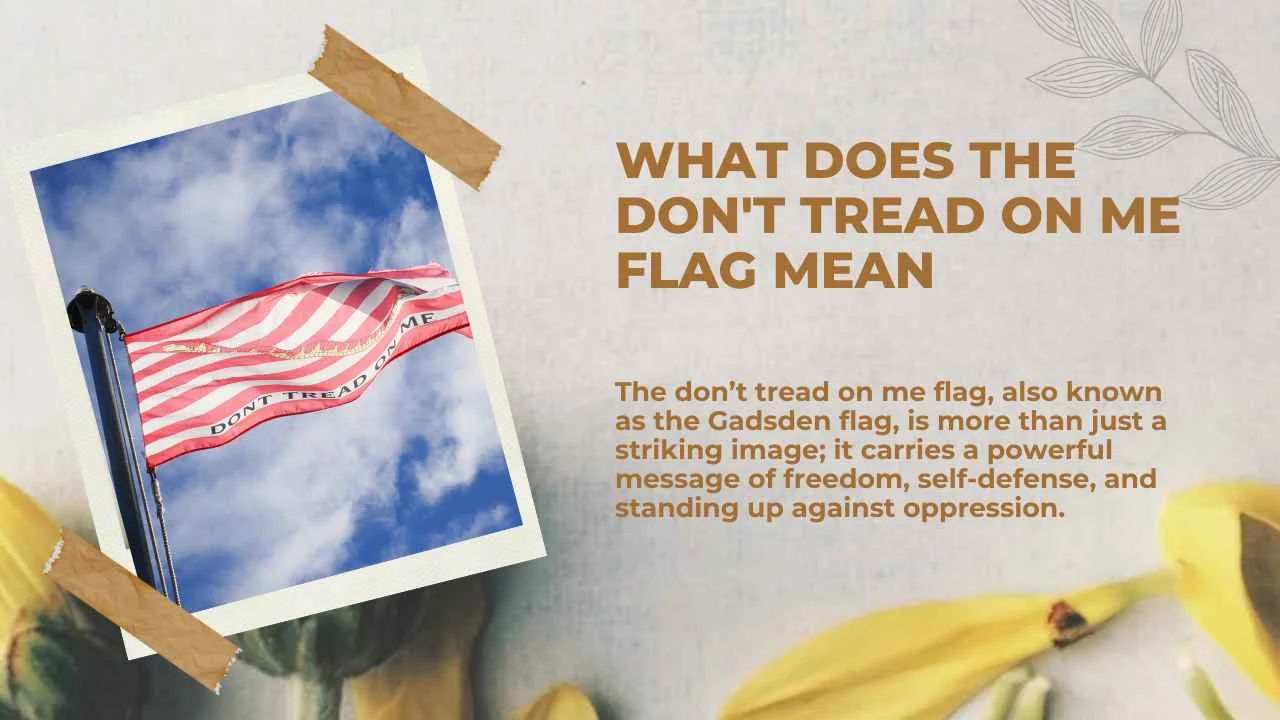

Have you ever seen a bright yellow flag with a coiled rattlesnake and the words “Don’t Tread On Me” and wondered what it truly stands for?
The don’t tread on me flag, also known as the Gadsden flag, is more than just a striking image; it carries a powerful message of freedom, self‑defense, and standing up against oppression.
In this article, we’ll break down exactly what the don’t tread on me flag means, explore its history, and explain why it’s still a symbol of independence today.
By the end, you’ll understand this iconic flag and its lasting significance in a clear, simple way.
What Does “what does the don’t tread on me flag mean” Mean? 🧠
The don’t tread on me flag i.e. the Gadsden flag features a coiled rattlesnake ready to strike and a yellow background with the words “Don’t Tread On Me.”
The meaning is straightforward: it’s a warning against oppression or injustice.
The rattlesnake, an animal that doesn’t strike unless threatened, symbolizes vigilance and readiness to defend.
The motto means “Don’t trample me or take away my freedom — step carefully, or there will be consequences.”
In short: what does the don’t tread on me flag mean = Gadsden flag = a symbol of liberty, self‑defense, and warning against tyranny.
Where does the don’t tread on me flag mean Commonly Used? 📱

While the flag originated in the 18th century, today you might see it in different settings and with varied meanings:
- Patriotic contexts — used by history buffs, American heritage groups, or individuals celebrating early American independence and Revolutionary War symbols.
- 🗳️ Political movements — especially among groups favoring personal freedom, limited government, or individual rights.
🪖 Military heritage and veteran groups — the flag’s roots trace back to the first navy/Marine use during the American Revolution.
- 📣 Protest or demonstration settings — sometimes displayed to signal resistance, self-defense, or opposition to perceived overreach.
- 🧑🤝🧑 Personal use — on bumper stickers, clothing, accessories, or online profiles to express independence or assertiveness.
Tone & Use: The original tone is defiant, patriotic, and protective. In modern times — depending on context — it can be patriotic, political, or controversial.
Examples of what does the don’t tread on me flag mean in “Conversation” 💬
Here are some imagined but realistic ways people might refer to the flag or its meaning in chat or social media.
Since the “flag” is a visual/political symbol, not slang, examples are more discussion‑oriented rather than casual texting slang:
- A: Have you seen that yellow flag with the snake and “Don’t Tread On Me”?
B: Yeah — that flag means “don’t mess with me.” It’s a symbol of freedom and standing up for yourself. - A: I put a bumper sticker on my car to show I value liberty.
B: Makes sense. For many, it stands for defending your rights and independence. - A: Someone at the rally had that flag — what does it stand for now?
B: Historically, it meant resisting tyranny. Nowadays people use it for personal or political freedom. - A: Is it just a patriotic symbol or something more controversial now?
B: Both. Originally patriotic, but over time it’s been adopted by different movements — so it can be loaded depending on who’s using it. - A: My history teacher showed us the flag origin — coiled snake, first American navy, warning to oppressors.
B: That’s right — its root message was unity, vigilance, and resistance against injustice.
When to Use and When Not to Use what does the don’t tread on me flag mean 🕓
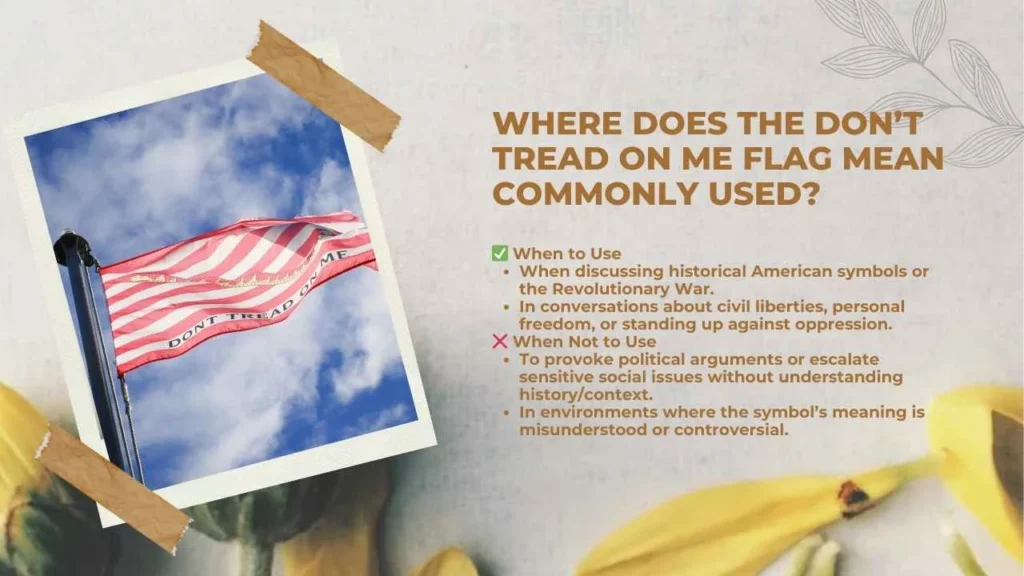
✅ When to Use
- When discussing historical American symbols or the Revolutionary War.
- In conversations about civil liberties, personal freedom, or standing up against oppression.
- When supporting military heritage or veteran history.
- For educational contexts, teaching US or world history.
❌ When Not to Use
- To provoke political arguments or escalate sensitive social issues without understanding history/context.
- In environments where the symbol’s meaning is misunderstood or controversial.
- In formal settings where political symbolism may be seen as divisive.
| Context | Example Phrase | Why It Works / Doesn’t Work |
| History Class | “The don’t tread on me flag was first flown in 1775 by American patriots.” | Clear historical explanation |
| Casual Chat | “I love that snake flag — it means freedom.” | Simple personal sentiment |
| Political Post | Using the flag to endorse a contentious policy | Can be polarizing depending on audience |
| Workplace | Displaying the flag at the office | Might be seen as political or divisive |
Similar Flag Symbols or Related Concepts 🔄
| Symbol / Phrase | Meaning / Use | When It’s Used |
| “Join, or Die” Cartoon | Early unity symbol of American colonies | Pre‑Revolution, colonial unity |
| First Navy Jack Flag | Alternately used naval banner with similar motto | Early American Navy ships |
| “Don’t Mess With Me” types of slogans | Modern equivalents expressing self‑defense and resistance | Protest signs, personal statements |
| Liberty / Independence Symbols (e.g. Liberty Cap) | Broader themes of freedom and independence | Political or historical contexts |
| Alternative Freedom Flags | Different designs used by groups claiming personal rights or defiance | Modern activism or political statements |
FAQs About what does the don’t tread on me flag mean ❓
Q: Who created the don’t tread on me flag?
A: The flag was designed in 1775 by Christopher Gadsden during the American Revolution.
Q: Why a rattlesnake and not something else?
A: The rattlesnake was chosen because, according to early American thinkers like Benjamin Franklin, it symbolized vigilance, independence, and a willingness to defend if provoked qualities they felt matched the American spirit.
Q: Does this flag have modern political meaning?
A: Yes. Over the years, it has been adopted by various political and libertarian groups, which makes its meaning vary depending on context. Some use it for patriotism, others for political or personal freedom advocacy.
Q: Is the flag always seen as positive or safe to display?
A: Not always. Because it’s been used by different groups with divergent views some controversial its display can be interpreted differently depending on audience, context, and location.
Q: Can I use it if I like it just for history or symbolism?
A: Yes, you can and many people do. But it helps to be aware of its history and modern associations before displaying it publicly, to avoid unintended interpretations.
Conclusion
The don’t tread on me flag isn’t just a bright graphic it’s a powerful symbol born in the struggle for liberty and resistance against tyranny.
Understanding what the don’t tread on me flag means helps you appreciate its historical roots and what it still represents today.
If you see it as a symbol of independence, a political statement, or a historical relic, remember that its meaning can shift depending on who uses it and why.
If you choose to use or display this flag, do so with awareness of its legacy and the meanings it carries.
Also Check These Posts
What Does Symbolism Mean | Meaning, Examples, and Usage for 2026
What Does Circumcised Mean in the Bible | Full Meaning Explained for 2026
What Does Circumcised Mean in the Bible | Full Meaning Explained for 2026